Anti-Hund
Theory and Design of Anti-Hund Molecules for Biomedical and Sustainable Energy Applications
About the project
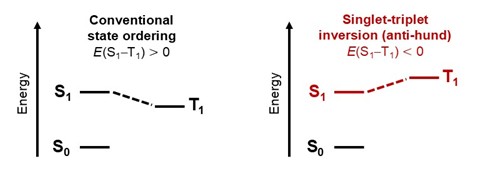
The energetic inversion of the first excited singlet and triplet states violates Hund's first rule; therefore, it is a very unusual situation, and so far, only a handful of such molecules has been identified. However, a negative singlet-triplet (ST) gap is an attractive property for numerous energy conversion, environmental, and biomedical applications. The key recent findings show that the ST gap inversion results from a subtle interplay between the electron exchange and correlation effects.
The project will develop and apply new theory and computational tools to better understand the electronic structure and discover new anti-Hund near-infrared (NIR) organic dyes for biomedical (fluorescence bioimaging and photodynamic therapy) and sustainable energy (light emitting diodes and photovoltaics) applications.
Subsequently, we will develop a framework for inverse molecular design based on the proposed models, high-throughput screening, and eoptimization algorithms. The joint application of the developed methods will lead to the design of new anti-Hund NIR emitters, absorbers, and sensitizers, whose photoconversion properties will be studied in detail.
Type of project
New Exploratory Research and Discovery (NERD) Programme – Novo Nordisk Foundation.
Section members involved in the project
Contact: Piotr de Silva
Piotr de Silva Professor Department of Energy Conversion and Storage Mobile: +45 93510819 pdes@dtu.dk
Divya Divya PhD Student Department of Energy Conversion and Storage Mobile: +919354063709 divdi@dtu.dk
Leonardo Evaristo de Sousa Researcher Department of Energy Conversion and Storage ledso@dtu.dk
Marc Hamilton Folkmann Garner Postdoc Department of Energy Conversion and Storage mhfga@dtu.dk
Lina Krarup Knudsen PhD Student Department of Energy Conversion and Storage lkrkn@dtu.dk